International Cooperation Projects

SLAIF

The Slovenian AI Factory will provide comprehensive AI and supercomputing solutions for research, public administration and business, bolstering innovation and European digital sovereignty.

SLAIF is an AI factory: an environment dedicated to design, test, and deploy solutions based on artificial intelligence and machine learning using access to supercomputing, large curated datasets, specialized talent and networks within the wider EuroHPC eco-system. Our mission is to accelerate collaboration among companies, universities, research organizations and public partners in order to provide efficient, innovative and independent or sovereign solutions in AI and ML technologies.

GENOME

GENerative and connected intelligence for 6G Open ManagemEnt (GENOME) research and training programme aims at investigating, developing/fine-tuning and validating large language models (LLMs) for the autonomous management and orchestration of various network technological domains (O-RAN, edge, cloud) through intent-based networking and task-agnostic network functions. It also targets the establishment of a connected intelligence framework for the coordination between these functions via on-the-fly protocol learning to mitigate conflicting management decisions and maximize utilization. Network configuration will also be generated automatically through innovative neuro-symbolic AI algorithms. Moreover, the transparency and resilience of the AI models is researched. All the developed components will be validated via both simulation and testbed experiments, and integrated into a final proof-of-concept. Besides, a detailed training plan is designed including schools, industrial days and soft-skills courses. It involves industrial partners to ensure that career perspectives of ESRs will be significantly increased by participation in the project. High quality dissemination and exploitation activities are also considered.

KReATIVE

EnerTEF responds to the soaring demand for reliable AI products in the evolving energy sector. It pioneers a Common Federated AI Testing and Experimentation Facility to bridge the gap between demand and limited availability of rigorously tested AI products. Aligned with European Commission initiatives, EnerTEF leverages foundational projects like the Common European Energy Data Space and AIoD. Through specialized ‘AI Living Labs,’ EnerTEF fosters collaboration between energy stakeholders and AI developers to create adaptive models that align with evolving energy systems. ‘Bridging Centralized Access’ ensures data privacy and security in federated testing, adhering to EU regulations and addressing ethical concerns. ‘Seamless Federated Integration’ tackles integrating AI technologies across domains, enhancing cross-sector collaboration. ‘Long-term Sustainability and Go-to-Market Strategy’ focuses on bringing AI innovations to market. In a nutshell, EnerTEF’s primary goal is to establish a Common European-scale Energy AI Federated TEF, facilitating extensive adaptation, validation, and upscale of AI tools and services across the energy sector. The project’s network of five primary nodes, complemented by three satellites, ensures a comprehensive approach to testing AI-based technologies in real-world operational environments. This setup contributes to the market uptake of trustworthy AI, ensuring their readiness, accessibility, and applicability to real-world scenarios.

EnerTEF

KReATIVE is a forward-thinking project aimed at transforming Kranj into a climate-neutral city by addressing its urban mobility challenges and fostering sustainable innovation. The project is designed to enhance collaboration across city departments, significantly reduce car dependency and promote eco-friendly transportation. At the heart of KReATIVE is the development and deployment of digital mobility platforms, such as ride-sharing services and on-demand transport systems, which provide flexible, sustainable alternatives to private vehicle use. KReATIVE emphasizes cross-departmental collaboration within the city’s governance structure. By breaking down silos between municipal departments, the project encourages a unified approach to urban planning and sustainability, ensuring that mobility initiatives align with broader climate neutrality goals. The project’s innovations are not limited to Kranj but are designed to be scalable and replicable across other European cities, particularly those facing similar challenges in their transition to climate-neutrality by 2030. A central feature of KReATIVE is its participatory approach, engaging various stakeholders—citizens, local businesses, city departments, and policymakers—in the design and implementation of sustainable mobility solutions. This involvement fosters a sense of community ownership and encourages behaviour change. The project leverages gamified platforms, where citizens are incentivized through rewards for reducing car use and increasing physical activity, creating a fun and impactful way to promote ecofriendly behaviours. KReATIVE also focuses on testing and implementing car-restrictive measures and temporary traffic regulations. These “living laboratories” generate real-time data and citizen feedback, allowing the city to evaluate the impact of such measures and make informed decisions on long-term implementation. By integrating advanced data-driven algorithms and digital tools, the project enables city planners to continuously monitor and optimize transportation systems, improving efficiency while reducing emissions. Through its focus on citizen engagement, technological innovation, and institutional collaboration, KReATIVE aims to create a resilient, future-oriented urban ecosystem that not only transforms Kranj’s mobility landscape but also serves as a blueprint for other cities seeking to achieve climate-neutrality.

GoToTwin

(2024-2027)
Project ID: IPA-ADRION00406
Acronym: GOTOTWIN
Starting date: 1. 9. 2024
Duration: 36 months
The GoToTwin project addresses the common challenge of accelerating the adoption and integration of renewable energy sources in the Adriatic Ionian region. The project leverages digital twin technology to tackle pressing energy and sustainability issues in the region.
The overall objective of the project is to establish a robust and transnational digital twin framework tailored for renewable energy applications. This framework will enable stakeholders to effectively manage energy systems, optimise resource utilisation, and enhance overall system efficiency. By harnessing advanced technologies like artificial intelligence and data analytics, stakeholders will be empowered to make well-informed decisions and maximise renewable energy generation.
The main outputs of the project include:

  • Development of a digital twin framework for renewable energy systems: This output involves the creation of a robust and adaptable digital twin framework specifically tailored for renewable energy applications in the Adriatic Ionian region. The framework will facilitate the effective management of energy systems, resource optimization, and enhanced system efficiency. The corresponding project activities entail conducting a thorough market assessment in the Adriatic Ionian region. It involves examining the current state of the renewable energy market, assessing technology readiness for digital twin implementation, evaluating legal and policy constraints, and identifying state-of-the-art solutions. Emphasis is placed on open-source options to enhance accessibility and collaboration.
  • Transnational integration and testing of four living labs into the digital twin platform and pilot activities focusing on solar, hydro, and wind power: This output encompasses the setup and integration of regional living labs and pilot projects dedicated to exploring the practical application of digital twin technology in renewable energy systems. These labs will provide the essential infrastructure for stakeholders to engage in experimentation and testing. The pilot action will demonstrate the digital twin platform replicability in a transnational perspective within the living lab environment.
  • The establishment of the GoToTWIN network: This output involves actively involving stakeholders from various sectors, including government entities, energy companies, local communities, industry associations, and academic institutions. Calls for experiments, thematic working groups, and training programs will facilitate collaboration, knowledge sharing, and capacity building among stakeholders.
  • Development of a Joint strategy for digital twins on renewable energy in the Adrion to encourage widespread adoption of digital twin solutions for renewable energy: This output focuses on the formulation of a joint strategy aimed at fostering the widespread adoption of digital twin solutions for renewable energy in the Adriatic Ionian region. These strategy will address regulatory barriers, promote favourable policies, and advocate for the utilisation of digital twin technology in renewable energy systems. It provides a shared vision for the future, offering insights into the current state of renewable energy systems, resource management practices, and environmental concerns within the Adriatic-Ionian region.
  • The project will benefit various regional stakeholders, including government entities, energy companies, local communities, industry associations, academic institutions, transmission system operators, research institutions, start-ups, and technology providers.
    The transnational approach is essential because energy challenges transcend national boundaries. By collaborating across borders, the project can leverage diverse expertise and resources to develop innovative solutions that address regional energy needs effectively.
    What sets the project apart is its focus on digital twin technology, which offers a novel approach to optimising renewable energy systems. Additionally, the emphasis on stakeholder engagement and policy advocacy ensures the sustainability and widespread adoption of the solutions.
    What sets the project apart is its focus on digital twin technology, which offers a novel approach to optimising renewable energy systems. Additionally, the emphasis on stakeholder engagement and policy advocacy ensures the sustainability and widespread adoption of the solutions.

    "The GOTOTWIN project published an Open Call for Experiments, inviting interested stakeholders to test innovative renewable energy solutions within digital twin living labs. Through this call, GOTOTWIN will select up to six participants from across the region and help them evaluate and validate novel approaches to renewable energy systems using digital twins."
    https://gototwin.interreg-ipa-adrion.eu/2026/06/27/gototwin-open-call-for-experiments/


    https://gototwin.interreg-ipa-adrion.eu/" The GoToTWIN project is co-funded by the European Union through the Interreg IPA ADRION programme.

    GOTOTWIN – Spodbujanje povezovanja in inovacij na področju obnovljivih virov energije s tehnologijo digitalnih dvojčkov

    Mihael Mohorčič, Odsek za komunikacijske sisteme (E6)


    Za obnovljive vire energije v jadransko-jonski regiji je značilna razdrobljenost in omejeno čezmejno sodelovanje energetskih sistemov. Projekt GOTOTWIN v okviru programa Interreg ADRION želi to stanje izboljšati s pomočjo zasnove in implementacije odprte platforme za integracijo digitalnih dvojčkov obnovljivih virov energije v širši regiji, ki bo pomagala deležnikom v realnem času spremljati osnovna sredstva, simulirati zapletene energetske scenarije in načrtovati naložbe v infrastrukturo. Pri tem projekt vključuje univerze, raziskovalne inštitute, ponudnike energije in tehnološka podjetja iz Grčije, Hrvaške, Slovenije, Srbije, Bosne in Hercegovine ter Severne Makedonije.

    Mapiranje področja obnovljivih virov in deležnikov

    Projekt se je začel z oceno stanja na področju obnovljivih virov energije, ki je pokazala ogromen neizkoriščen potencial vetrnih, sončnih, vodnih in biomasnih virov v regiji ter poudarila, da lahko tehnologija digitalnih dvojčkov pomaga pri boljšem izkoriščanju teh virov. Poleg tega je študija izpostavila ključni pomen sodelovanja med državami članicami in nečlanicami EU za doseganje ciljev evropskega zelenega dogovora in načrta REPowerEU, pri čemer imajo ključno vlogo naložbe v platforme digitalnih dvojčkov in usklajene politike.

    Sočasno so projektni partnerji pod vodstvom raziskovalcev z IJS izvedla mapiranje deležnikov na področju obnovljive energije. S preiskavo nacionalnih ekosistemov je bil ustvarjen obsežen seznam operaterjev elektrarn in omrežij, regulatorjev, občin, raziskovalnih laboratorijev in inštitutov, tehnoloških ponudnikov in nevladnih organizacij. Da bi zagotovili vključenost vseh ključnih akterjev, je postopek mapiranja sledil štirim strukturiranim korakom, od identifikacije preko konsolidacije in kategorizacije do preverjanja. S tem postopkom je bil ekosistem deležnikov, katerega osnovo predstavljajo uveljavljena omrežja na področju energetike, razširjen z novimi deležniki kot so zagonska podjetja in lokalne energetske skupnosti.

    Zasnova arhitekture

    V naslednjem koraku so projektni partnerji v sodelovanju z deležniki ter s pomočjo vprašalnikov, intervjujev in delavnic zbrali funkcionalne in nefunkcionalne zahteve za platformo digitalnih dvojčkov. Zahteve poudarjajo potrebo po zajemanju podatkov v realnem času, visoki prepustnosti podatkov, varni komunikaciji, uporabniku prijaznih vmesnikih, združljivosti z obstoječimi sistemi in skladnosti s predpisi EU o podatkih. Za prikaz in validacijo delovanja platforme znotraj projekta so bili določeni trije prednostni pilotni primeri uporabe:

    • deljenje podatkov med obnovljivimi viri in operaterji omrežij,
    • storitve napovedovanja in optimizacije na osnovi modelov umetne inteligence, in
    • eksperimentalno okolje za testiranje novih tržnih in regulatornih scenarijev v varnem virtualnem okolju.

    Na podlagi zbranih zahtev je bila določena tronivojska konceptualna arhitektura, v kateri:

    • komunikacijski prehod povezuje sredstva obnovljivih virov energije (vetrne, sončne in hidroelektrarne ter okoljske in vremenske senzorje) z uporabo standardnih protokolov.
    • jedro platforme digitalnih dvojčkov zajema, shranjuje in analizira podatke.
    • vizualizacija ponuja nadzorne plošče za spremljanje v realnem času, napovedno vzdrževanje sredstev, napovedovanje proizvodnje in porabe energije ter agregacijo virov v virtualne elektrarne.

    Spodnji diagram prikazuje podatkovni tok od obnovljivih virov energije in senzorjev skozi jedro platforme digitalnih dvojčkov do različnih vizualizacijskih modulov, ki se lahko prilagodijo potrebam operaterjev, regulatorjev ali raziskovalcev.
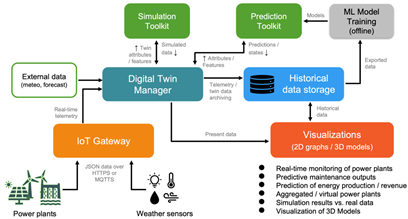
    Slika 1: Zasnova platforme digitalnih dvojčkov za obnovljive vire energije projekta GOTOTWIN

    Predlagano tronivojsko arhitekturo smo v projektu realizirali kot modularen, storitveno-orientiran, oblačni sistem. Celotna zasnova temelji na odprtokodnih tehnoloških komponentah Kubernetes za orkestriranje mikrostoritev in ustrezno prilagajanje sistemskih virov, Eclipse Hono kot prehod interneta stvari (angl. Internet of Things gateway) za varno povezovanje sredstev in senzorjev, Eclipse Ditto za upravljanje stanj digitalnih dvojčkov, InfluxDB za shranjevanje podatkovnih časovnih vrst in Grafana za zagotavljanje interaktivnih nadzornih plošč. Uporaba odprtih standardov in odprtokodnih orodij zagotavlja interoperabilnost in preprečuje odvisnost od enega samega ponudnika. Takšna zasnova omogoča modularnost, prilagodljivost, interoperabilnost, varnost in razširljivost npr. z moduli za napovedovanje, optimizacijo, trgovanje in analizo politik.

    Sodelovanje z deležniki in usklajevanje energetskih politik

    Poleg tehnične zasnove in izvedbe platforme digitalnih dvojčkov za obnovljive vire energije je pomemben del projekta GOTOTWIN tudi vzpostavitev sodelovanja z deležniki in usklajevanje energetskih politik v širši regiji. V ta namen projekt organizira različne delavnice in dogodke.

    Prva dvodnevna delavnica, ki je potekala maja 2025 v grškem mestu Kozani pri partnerju University of Western Macedonia, je obsegala tri vsebinsko ločene dogodke. Na prvem dogodku so udeleženci primerjali različna ogrodja mikrostoritev, odprtokodne komponente in orodja ter preučevali, kako najbolj učinkovito v bodočo platformo povezati senzorje, robne naprave in sredstva obnovljivih virov energije v obstoječih živih laboratorijih partnerjev iz Severne Makedonije, Srbije, Grčije in Hrvaške. Razprava je zajela tudi čezmejno eksperimentiranje in za to potrebno uskladitev vrst senzorjev, podatkovnih formatov in vmesnikov. Drugi dogodek je bil osredotočen na energetske politike in regulativo. Projektni partnerji in zunanji udeleženci so kot ključne izzive za čezmejno uporabo digitalnih dvojčkov in energetsko povezovanje identificirali različna tveganja kibernetske varnosti, vprašanja lastništva podatkov in neskladne regulatorne okvire med državami. Tretji dogodek z gosti iz vladnih agencij, energetskega regulatorja in industrije se je podrobneje posvetil vprašanjem o kibernetski varnosti, interoperabilnosti in upravljanju podatkov. Udeleženci v razpravi so izpostavili potrebo po usklajevanju predpisov med državami, določitvi jasnih pravil o lastništvu in zasebnosti podatkov ter uvedbi spodbud za naložbe v infrastrukturo digitalnih dvojčkov. Poudarili so tudi pomembnost vključevanja državljanov in malih podjetij v energetsko tranzicijo z namenom izkoriščanja digitalnih dvojčkov tako za družbene inovacije kot tehnično optimizacijo.

    Drugo dvodnevno delavnico je decembra 2025 v Ljubljani gostil Institut “Jožef Stefan”. S to delavnico je projekt označil dosežek pomembnega mejnika, to je delujoč prototip platforme digitalnih dvojčkov za obnovljive vire energije projekta GOTOTWIN. Delavnica je obsegala dva dogodka: prvi je bil usmerjen v mreženje in vključevanje deležnikov, drugi pa je namenjen začetku integracije obnovljivih energetskih sistemov iz živih laboratorijev v Severni Makedoniji, Srbiji, Grčiji in na Hrvaškem v platformo digitalnih dvojčkov. Odprta Delavnica o digitalnih dvojčkih za energetsko tranzicijo, s številnimi povabljenimi deležniki in sorodnimi projekti, je obsegala 18 predstavitev, namenjena pa je bila tako razširjanju dosežkov projekta GOTOTWIN kot predstavitvam sorodnih projektov in aktivnosti drugih deležnikov. Drugi dogodek je bil zaprte narave in namenjen projektnim partnerjem za pridobivanje praktičnih izkušenj z integracijo obnovljivih virov energije v platformo ter preskušanju zajemanja podatkov v realnem času, podprtih komunikacijskih protokolov in vključenih modulov za vizualizacijo.
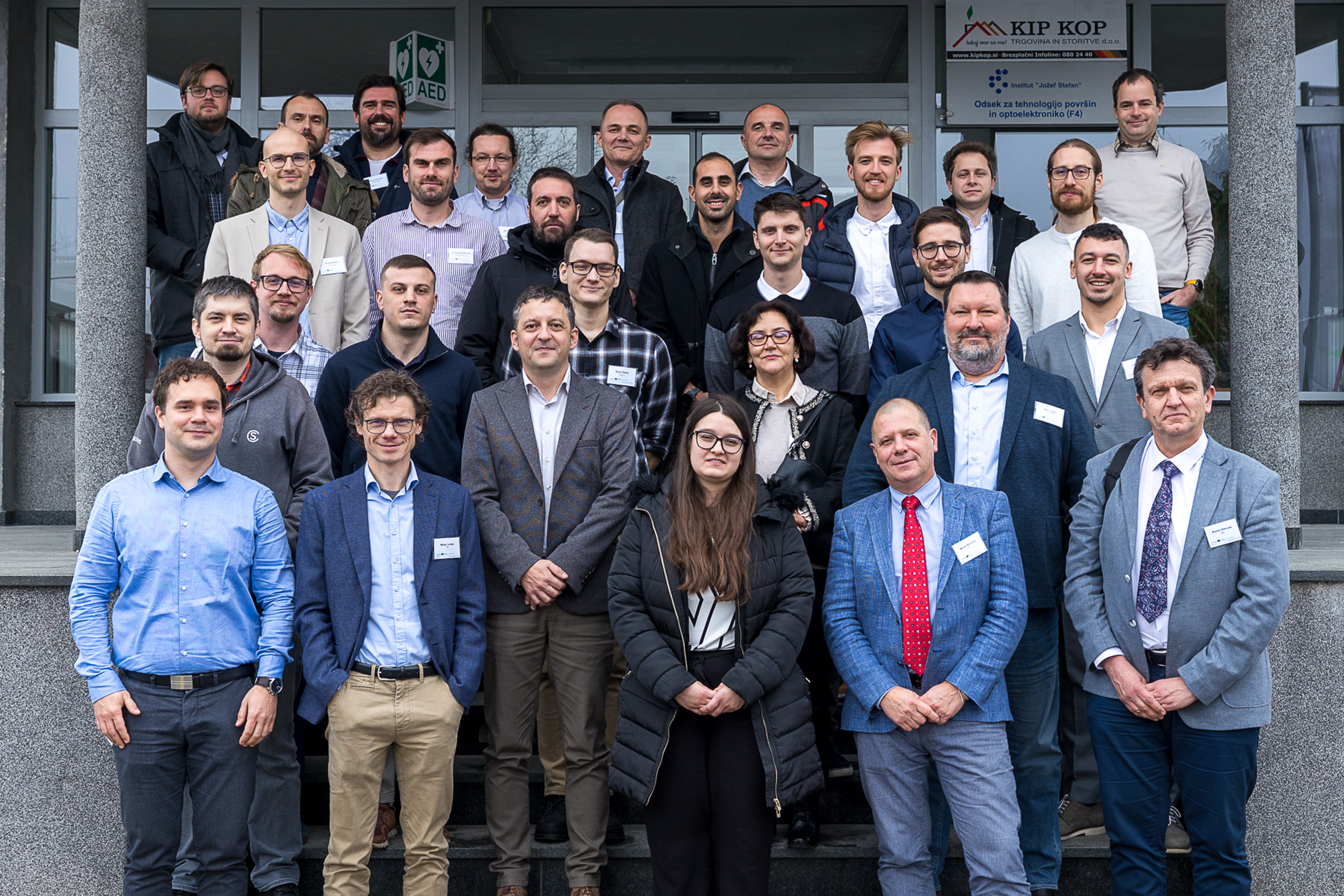
    Slika 2: Udeleženci delavnice GOTOTWIN na IJS (©Marjan Verč, 2025)

    Trenutno stanje in nadaljnji koraki

    Do začetka leta 2026 je projekt GOTOTWIN zaključil vrsto osnovnih študij in poročil, določil arhitekturo platforme digitalnih dvojčkov, realiziral delujoč prototip in vzpostavil sodelovanje z deležniki na področju obnovljivih virov energije v regiji. Partnerji iz živih laboratorijev sedaj vključujejo svoje vire v prototip platforme digitalnih dvojčkov, ki mogoča integracijo senzorjev, zajem podatkov v realnem času preko Eclipse Hono, shranjevanje časovnih vrst podatkov v bazo InfluxDB in njihovo vizualizacijo preko interaktivnih nadzornih plošč v okolju Grafana. Sočasno partnerji razvijajo modele umetne inteligence za kratkoročno napovedovanje proizvodnje in porabe energije ter zaznavanje anomalij, pripravljajo pa tudi čezmejne eksperimente, ki bodo povezovali žive laboratorije iz različnih držav.

    V naslednji fazi bo platforma razširjena z vključitvijo naprednih optimizacijskih algoritmov za uravnavanje ponudbe in povpraševanja, orodij za simulacijo trga in testiranje regulatornih scenarijev ter modulov za analizo energetskih politik. Ob tem bo projekt nadaljeval z vključevanjem deležnikov prek različnih delavnic in tematskih dogodkov, končni cilj pa je postati referenčna točka za regionalno sodelovanje na področju obnovljivih virov energije.

    Projekt GOTOTWIN spodbuja integracijo obnovljivih virov energije v jadransko-jonski regiji s pomočjo napredne tehnologije digitalnih dvojčkov. Pobuda z namenom izboljšanja čezmejnega izkoriščanja obnovljivih virov združuje raziskovalne inštitute, univerze in energetska podjetja iz šestih držav. Začetna faza je vključevala celovito mapiranje trga, deležnikov in regulative, kar je razkrilo velik neizkoriščen potencial regije, čemur je sledila zasnova platforme digitalnih dvojčkov. Razvita platforma digitalnih dvojčkov temelji na odprtokodnih orodjih, ki omogočajo varno zajemanje podatkov v realnem času in simulacijo kompleksnih scenarijev. Decembra 2025 je bil v Ljubljani predstavljen prvi delujoč prototip platforme, v katero se zdaj povezujejo živi laboratoriji (angl. living labs) projektnih partnerjev iz Severne Makedonije, Srbije, Grčije in Hrvaške. Platforma je zasnovana modularno in omogoča spremljanje sredstev, napovedno vzdrževanje in vizualizacijo energetskih tokov. Trenutno projektni partnerji razvijajo modele umetne inteligence za kratkoročno napovedovanje proizvodnje in porabe energije ter zaznavanje anomalij. Poseben poudarek projekta je namenjen usklajevanju regulative in energetskih politik ter zagotavljanju kibernetske varnosti v energetskem omrežju. V naslednji fazi bodo v platformo vključeni algoritmi za optimizacijo trgovanja in uravnoteženje omrežja. Projekt GOTOTWIN tako postavlja temelje za regionalni energetski prehod, ki temelji na digitalizaciji in skupnih standardih.
    HEDGE-IoT

    HEDGE-IoT proposes a novel Digital Framework which aims to deploy IoT assets at different levels of the energy system (from behind the- meter, up to the TSO level), to add intelligence to the edge and cloud layers through advanced AI/ML tools and bridge the cloud/edge continuum introducing federated applications governed by advanced computational orchestration solutions. The HEDGE-IoT Framework will upgrade the RES-hosting capacity of the energy systems and will unleash a previously untapped flexibility potential. It will increase the resilience of the grid, create new market opportunities and promote advances in IoT standardization, by introducing and managing a plethora of diversified, interoperable energy services over scalable and highly distributed data platforms and infrastructure. The multi-dimensional framework of HEDGE-IoT comprises the following pillars: (a) the Technology Facilitator Pillar will exploit the computational sharing by offloading applications on the grid edge, towards providing a set AI/ML federated learning and swarm computing applications; (b) the Interoperability Pillar, which leverages on leading-edge interoperable architectures, such as the Data Space architectures; (c) the Standardisation Pillar will enable all involved platforms, systems, tools and actors to seamlessly communicate and exchange data in standardized formats using widely used standards, such as SAREF, etc.; (d) the Digital Energy Ecosystem Enabling Pillar will ensure the creation of an ecosystem facilitating the increased integration of RES and characterized by resilience. Liaisons with EU initiatives for IoT and digitalization will be established (e.g., the AIOTI) and the engagement of stakeholders will be ensured by addressing IoT ethics and cultivating trust among end-users, thus promoting inclusivity. Scalability and replicability studies will be performed and connections with innovators and SMEs will be established through the Open Call mechanism of the project.

    Based on the data collected by the partners in the scope of the Slovenian pilot and the understanding of the physical reality behind the phenomena, JSI will develop algorithms for real-time assessment and prediction of the state of the assets. To achieve real-time response, the algorithms will be developed for hierarchical execution using edge computing. Our ultimate goal is to deploy the software we developed during DiTeR and Trafoflex projects locally, including local AI-based weather forecast.

    SiQUID

    (DIGITAL, 2023-2025)
    SiQUID will implement quantum key distribution (QKD) lSiQUID will implement quantum key distribution (QKD) links between multiple government nodes in Slovenia and a test-bed quantum network between research institutions in Ljubljana for advanced quantum communications protocols. We will coordinate our efforts with public and industrial stakeholders, and we will train key personnel, young researchers and engineers in quantum technology. The first test nodes implemented will be based on our recent first demonstration of QKD links between three European countries (arXiv:2203.11359-paper attached). We will harness directly modulated laser diodes to ensure the phase randomization between adjacent pulse sequences, and we will use a high-assurance random number generator to randomize the choice of the state preparation basis. These improvements promise a higher level of security, a larger range, and a higher key rate. This will form the basis for the implementation of the QKD links between government nodes. To reduce the cost of future QKD networks, SiQUID will investigate the feasibility of cheaper alternatives for the detection nodes by balancing cost against the key rates achievable in metropolitan links. At the same time, we will use superconducting nanowire single-photon detectors (SNSPDs) to implement high-efficiency links. We will use these to test long-distance links between distant cities in Slovenia, and to nodes close to neighboring countries. Moreover, we will test advanced quantum communication protocols like measurement-device-independent (MDI) QKD and the long-distance distribution of entanglement to further increase the security of QKD implementations, and to prepare the ground for a future full-fledged quantum communication network. We are in close contact with QCI initiatives in neighbouring countries to facilitate the harmonisation of the national efforts, and to facilitate future cross-border links and the implementation of the space segment of EuroQCI.