Applied Research Projects
Predictive models for Dynamic Thermal Rating of power lines
(2026 - 2029) co financed by Operato
In the last years, we witness an extremely rapid development of the electricity market and services, mainly due to the inclusion of renewable electricity resources in the network, which can cause extensive and rapid changes in the load. As a result, existing power lines have already exhibited bottlenecks that have caused system-wide instabilities and blackouts in the past. The transmission system operators (TSOs) are thus striving to increase the transmission capacity of existing overhead lines without compromising system stability. Namely, the transmission capacity, i.e., the maximum allowed current, also called ampacity, is limited by the maximum allowed temperature of the conductor, which is, for safety reasons, traditionally assessed for the most unfavorable weather conditions. One of the most promising solutions to this problem is to dynamically determine the transmission capacity considering the current weather conditions or the weather forecast. Using this type of Dynamic Thermal Rating (DTR) approach, line ratings can surpass the conservative static values by a significant margin for the majority of the year. However, the quality of the rating forecast is highly dependent on the quality of the weather forecasts.Recently, a growing interest has been shown in applying probabilistic machine-learning approaches to weather-based DTR procedures, in order to account for the uncertainty of forecasting ambient conditions. However, several important aspects have not been previously addressed. First, DTR depends highly on the weather physical properties that show the concept drift phenomenon, i.e., their characteristics change over time. Next, in the existing work on DTR forecasting, the classical solution is to learn a single-output predictive model. Structured output prediction models have not been considered so far. Moreover, previous work considers forecasting solutions for single transmission lines (spans) and ignores the information collected from/at other lines/sites in the vicinity, i.e., the spatial autocorrelation that characterizes geophysical phenomena. Furthermore, weather data is inherently seasonal/cyclical. Since the DTR process is highly dependent on the weather, it is inherently also affected by temporal autocorrelation. Finally, when forecasting DTR, the transformation of the weather parameters/conditions into ampacity changes the statistical properties of the prediction errors into a non-Gaussian distribution. Studies have shown that for non-Gaussian distributions, entropy-based measures are more suitable for training.The main objective of the project is an in-depth comparison of several different predictive models for DTR of power lines, taking into account local weather station measurements, conductor measurements, and NWPs. This project also aims to incorporate multimodal learning approaches by integrating LiDAR data to enhance the spatial characterization of transmission environments and developing deep learning architectures for probabilistic DTR forecasting. More specifically, the project aims to address all the issues listed above by: (1) Explicit consideration of spatial and temporal autocorrelation, and the investigation of their effect at different extents in predictive modeling of DTR; (2) Investigation of the effect of the structured output prediction approach in an adaptive learning setting, to account for the concept drift phenomenon; (3) Investigation of the effect of the specific learning algorithm used; (4) Integration of multimodal learning techniques, leveraging LiDAR data, deep learning models, and heterogeneous data fusion for improved predictive performance; (5) Extensive experimental evaluation that will orthogonally investigate all these considerations on data for conductor lines spread over the geographic area of Slovenia. As a final outcome, the best-performing model(s) will be implemented as prototype model(s) for validation in a real-time operational DTR environment.
AeroDrops
AeroDrops (2025)
AeroDrops is the first device capable of selectively detecting airborne droplets in real time. The device detects and counts respiratory droplets, enabling smart, data-driven ventilation control that helps reducing infection risk – addressing a key public health challenge highlighted during the COVID-19 pandemic.
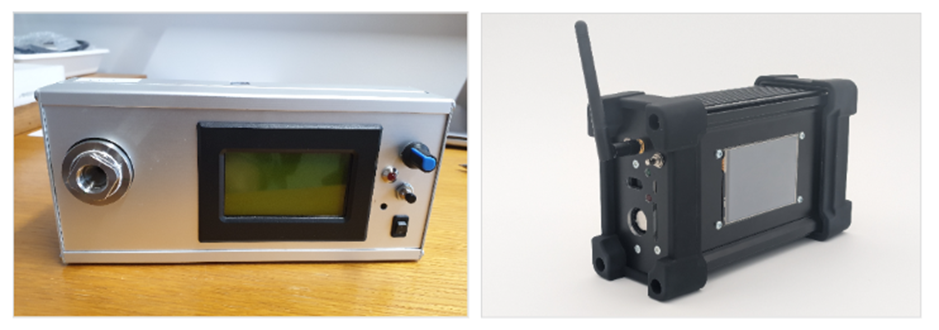
The technology was developed at the Jožef Stefan Institute. To raise the technology readiness level and bring solution closer to the market, the project received funding through RSF-IND call at JSI. Departments F5 and E6 are collaborating with industrial partners Nanotul d.o.o. and Comsensus d.o.o. to develop a market-ready device and further develop the technology.
TRAFOFLEX – Advanced concept of efficient use of transformers leveraging the DTR technology
OPERATO d.o.o. (2021-2023)
We estimate that in the Slovenian distribution approx. 100 transformer replacements per year occur, which are replaced before the end of their service life due to overloads. We have conservatively estimated that we can safely overload – according to the nominal value – transformers by 15%. With an average 2% increase in workload, this means that its replacement is delayed by 7 years. The average cost of replacing the transformer was taken in the amount of € 15,000. Based on this, we calculate the economics by calculating the investment lag (considering the 15-year period). In order to cover the whole of Slovenia with such systems, we estimate the investment at € 4.5 M (total cost of ownership – TCO for 15 years). With the assumptions used, the net benefits amount to approx. 4 M €, and the investment would be repaid in 4 years. The results of the first DTR tests for transformers show that it is possible to safely overload them in the coldest periods, when we usually have peak loads, even significantly more than 15%, so the savings can be even greater. We also do not mention here the benefits of asset management, which are still difficult to evaluate at the moment, as this task will develop the concept. The benefits of ELES have also not been evaluated, as they are difficult to extract from the comprehensive SUMO System which is already in use.
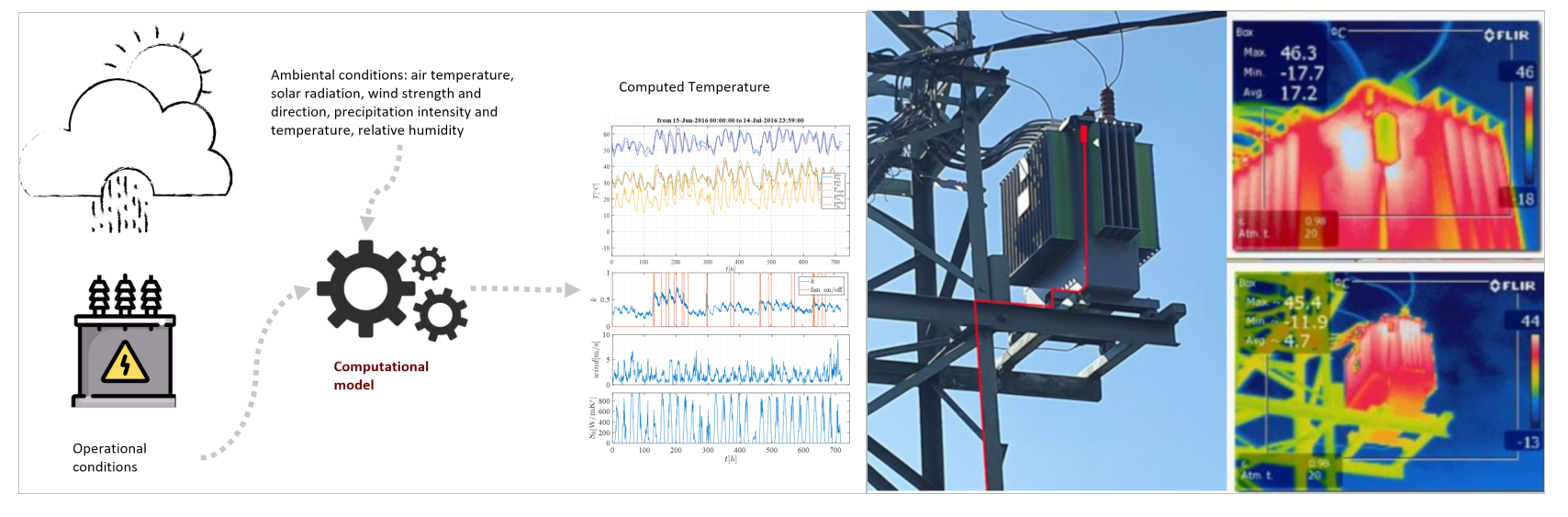
The project aims to increase the load capacity of transformers (TR) in a safe way, without adversely affecting the service life and thus gain, together with flexibility services, additional space for managing peak loads, especially on LV networks. So far, the calculation of DTR for TR has been performed only within the framework of ELES’ SUMO project for two cases of energy TR and for one case of distribution TR in TP of mast construction – in all cases TR was directly exposed to weather influences. In the framework of this project, we want to extend the applicability of the DTM model to the consideration of typical buildings in which TRs are located. The ultimate goal of the project is to develop and test the concepts of advanced use of transformers for the purposes of operation, flexibility market and asset management, and thus to prepare the ground for mass implementation of the technology.