
Analysis of dynamic thermal rating in TransnetBW using measured weather data

The transfer capabilities of overhead power lines are limited by the critical power line temperature that depends on the magnitude of the transferred current and the ambient conditions. To utilize existing power lines more effectively and more safely, concerning the critical power line temperatures, and to enforce safety measures during potentially dangerous events, Dynamic Thermal Rating (DTR) systems have been developed for the past 30 years. DTR allows transmission system operator (TSO) to monitor and predict the maximal allowed ampacity (transfer capability) of the power grid based on weather measurements and forecast systems.

This project was a pilot project with German TSO TransnetBW with the goal to provide weather data analysis and dynamic thermal rating evaluation to assist TransnetBW in better understanding of their system and to maximise the use of dynamic line rating.
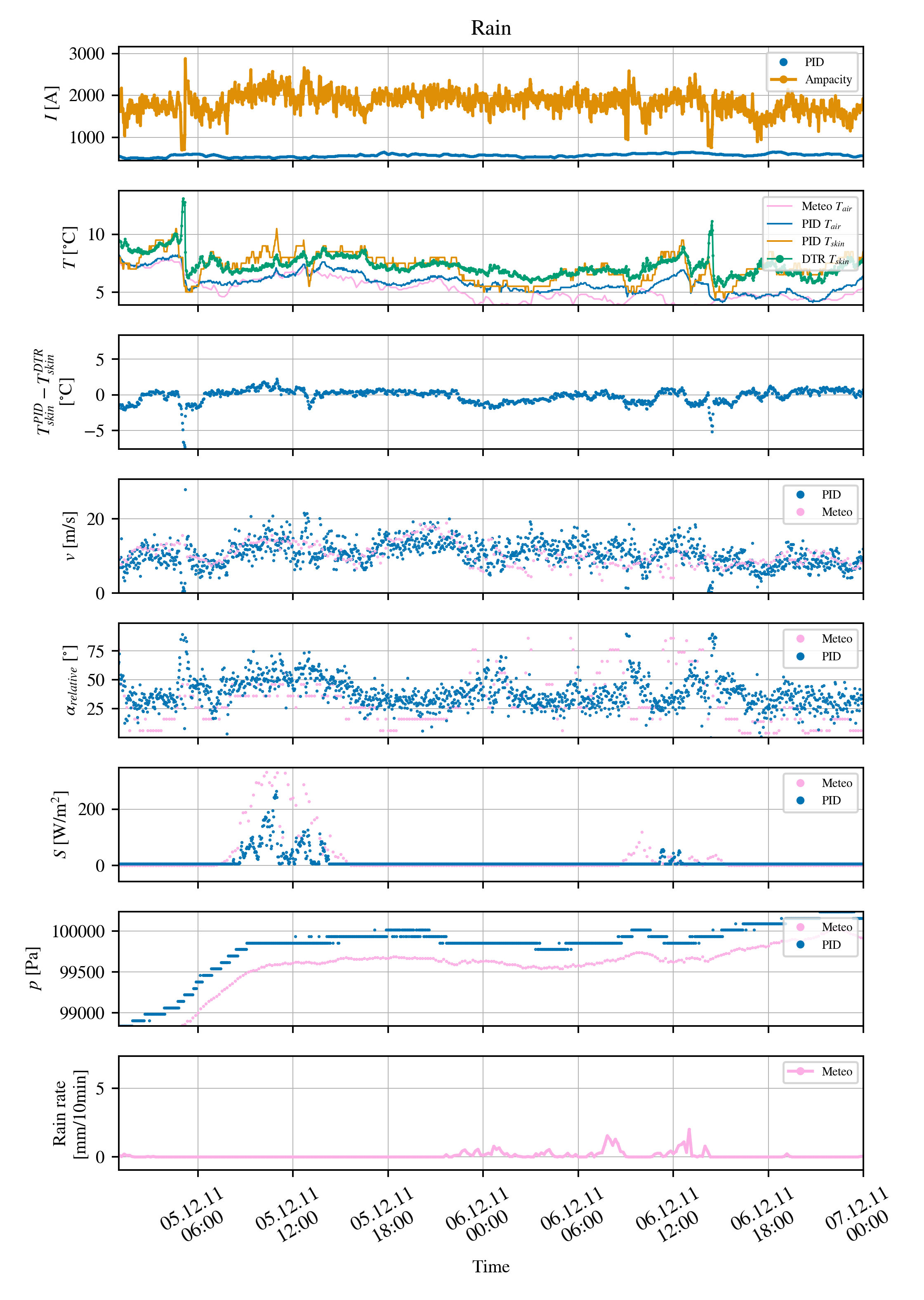
An example of DTR performance in rainy conditions. The first section shows the operating current and the calculated ampacity. Next are the measured skin temperature of the Al/St line, and air temperature (both from the sensor on the mast (PID), and from the meteorological station (Meteo), and the calculated line temperature. Below are the relevant weather measurements.

TransnetBW provided power line properties, weather and current measurements from 3 different sensor, for one location in time interval from April 2011 to June 2014 and from July 2018 until the beginning of the project. We first assessed the quality of the provided data and performed some basic statistical analysis. Additionally, we used meteorological data from Der Deutsche Wetterdienst weather station, located 17 km from the point of interest as an independent measurement source. We looked at the intervals with missing or corrupt data and interpolated the missing data where possible, to obtain the intervals with all of the variables needed for DTR simulations.

We used CIGRE TB601 based algorithm, written in C++14 and parametrised the 243-AL1/39-ST1A type power line according to the data provided by TransnetBW, standard recommendations and data from the scientific literature. We then run the DTR simulations. We first established confidence in the DTR model by a static temperature rise test and basic sensitivity analysis. We compared the computed temperatures with the measured ones, and looked at some examples with different weather scenarios.

We next discussed the ampacity distributions, and examined cases where dynamic ampacity falls under the static limit. We addressed the ampacity distribution uncertainty, where we used Monte Carlo simulations to generate distributions of ampacity. We simulated the uncertainty of the input parameters via the DTR error, which was evaluated as the difference between the calculated and measured skin temperature. We showed how the implementation of DTR in the system would increase the operating capacities.
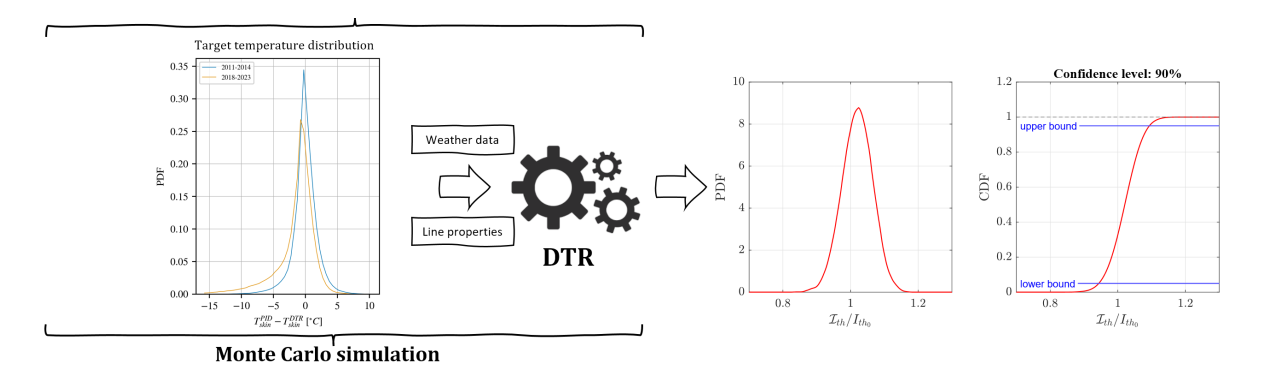
Scheme of Monte Carlo simulations used to assess uncertainty.
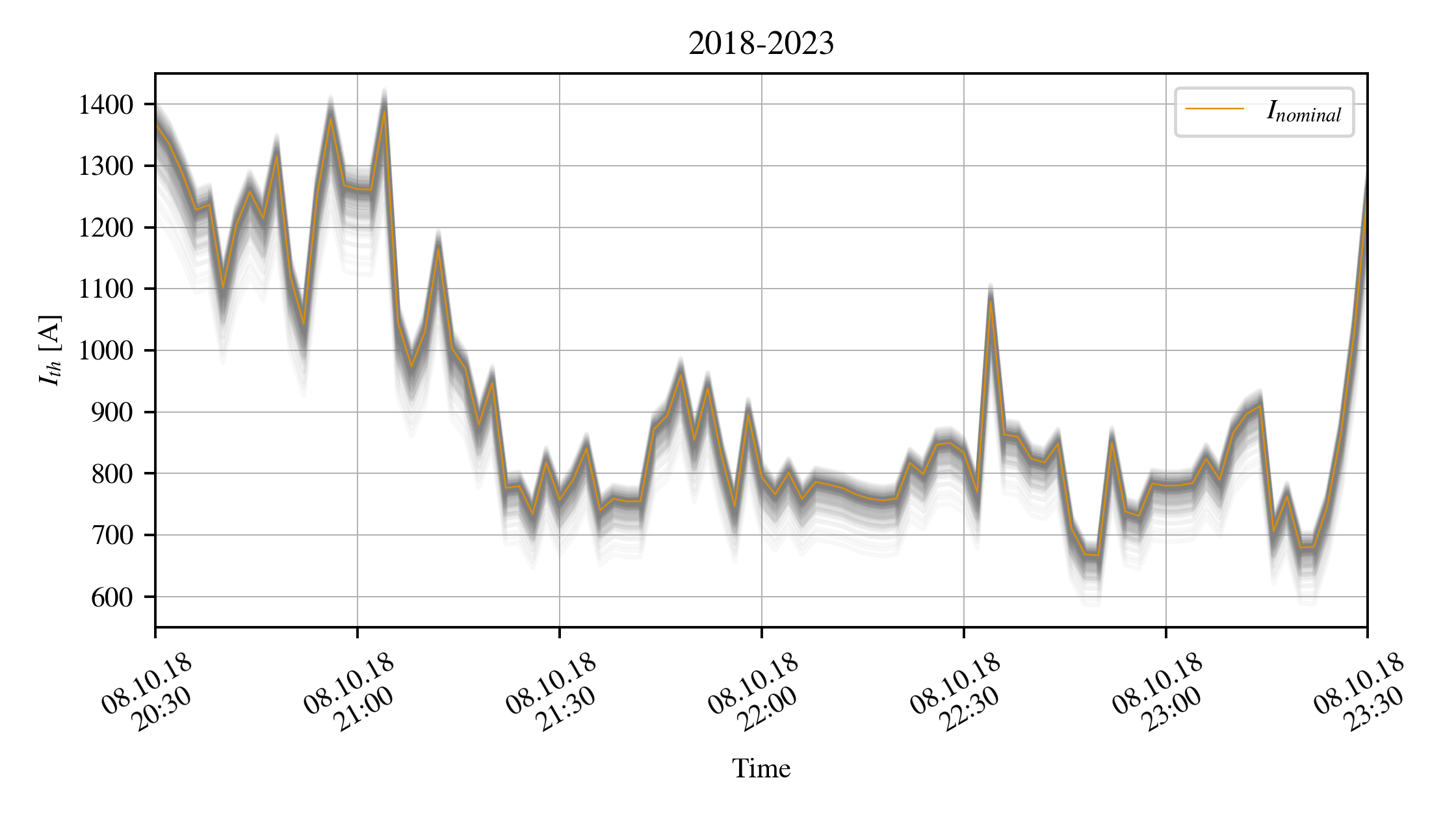
Visualisation of ampacity spread based on the calculated ampacity uncertainties for October 2018.

Funding

P-Lab team


M. Chen, Y. Lu, L. Cheng, R. Zhu, K. Tao, Y. Li, M. Wahab; Lightweight underwater acoustic time-frequency separation network for efficient marine target recognition, Ocean Engineering, vol. 343, 2026 [DOI: 10.1016/j.oceaneng.2025.123234] ::
Q. Xiao, C. Wang, Y. Wu, G. Chen, L. Wang, M. Wahab; Understanding fretting fatigue in dovetail joints: Slip accumulation, stick-slip evolution, joint angle and crack initiation, Tribology International, vol. 214, 2026 [DOI: 10.1016/j.triboint.2025.111368] ::
P. Hung, H. Nguyen-Xuan, M. Wahab, C. Thai, P. Phung-Van; Flexoelectricity effects on smart piezoelectric nanoplates using an isogeometric analysis-based Chebyshev shear deformation theory, Computers and Structures, vol. 320, 2026 [DOI: 10.1016/j.compstruc.2025.108033] ::
H. Zahran, A. Zinovev, D. Terentyev, A. Aouf, M. Wahab; A deep learning approach to predict cyclic softening behaviour of irradiated and non-irradiated RAFM steels under low cycle fatigue, European Journal of Mechanics / A Solids, vol. 117, 2026 [DOI: 10.1016/j.euromechsol.2026.106021] ::
Y. Zhang, D. Chen, Y. Wu, L. Wang, M. Wahab; Cross-configuration assessment of functionally graded adhesives in single-lap joints via an elastoplastic ductile-damage framework, International Journal of Adhesion and Adhesives, vol. 147, 2026 [DOI: 10.1016/j.ijadhadh.2026.104285] ::
C. Thai, P. Hung, M. Wahab, P. Phung-Van; Isogeometric evaluation of higher-order shear deformation theories for functionally graded magneto-electro-elastic nanoplates under nonlocal strain gradient elasticity, Engineering Analysis with Boundary Elements, vol. 188, 2026 [DOI: 10.1016/j.enganabound.2026.106745] ::
Y. Ma, Q. Yang, R. Zhu, Y. Li, M. Wahab; Underwater Image Enhancement Via Dual-Path Frequency-Domain Fusion Network, IEEE Transactions on Circuits and Systems for Video Technology, 2026 [DOI: 10.1109/TCSVT.2026.3676253] ::
Y. Lu, Z. Zhu, Y. Li, H. Liu, J. Hou, C. Zhou, M. Wahab; LDS-former: A lightweight dual-stream transformer for real-time acoustic emission monitoring of crack evolution in offshore steel structures, Advanced Engineering Informatics, vol. 74, 2026 [DOI: 10.1016/j.aei.2026.104635] ::
M. Wahab; Ballistic performance of a novel auxetic core in sandwich structures under impact loading, Jnl of Sandwich Structures & Materials, 2026 ::
Z. Wang, J. Liu, K. Li, X. Fang, M. Wahab, Z. Cai; Combined laser shock peening and shot peening for improving fretting wear and low-cycle fatigue performance of Ti-6Al-4V, Optics and Laser Technology, vol. 203, 2026 [DOI: 10.1016/j.optlastec.2026.115900] ::
S. Qin, J. Huang, S. Li, Y. Zhou, M. Wahab; Novel two-stage adaptive weight coefficients for Finite Element Model Updating of a cable-stayed bridge via sensitivity analysis and Kriging model, Mechanical Systems and Signal Processing, vol. 231, 2025 [DOI: 10.1016/j.ymssp.2025.112674] ::
L. Ho, T. Bui-Tien, M. Wahab; A two-step failure identification approach using a stochastic optimization-based ensemble learning model for beams without pristine data, Engineering Structures, vol. 334, 2025 [DOI: 10.1016/j.engstruct.2025.120253] ::
Q. Xiao, C. Wang, B. Ahmed, D. Wang, Z. Cai, L. Wang, M. Wahab; Prediction of fretting fatigue lifetime of dovetail joints using a Modified Theory of Critical Distances, Tribology International, vol. 209, 2025 [DOI: 10.1016/j.triboint.2025.110728] ::
C. Li, S. Han, C. Wang, A. Amanov, L. Wang, M. Wahab; A multiscale finite element approach to analyse the effect of shot peening-induced surface roughness on fretting fatigue crack initiation, Results in Engineering, vol. 26, 2025 [DOI: 10.1016/j.rineng.2025.104998] ::
X. Fang, Z. Wang, M. Wahab, J. Gong, X. Liu, X. Liu, Z. Cai; Fretting wear mechanism of GH4169 dovetail joint specimens treated with hybrid laser shock peening, Tribology International, vol. 209, 2025 [DOI: 10.1016/j.triboint.2025.110740] ::
J. Liu, X. Wang, A. Zinovev, D. Terentyev, L. Wang, M. Wahab; A modified low cycle fatigue Chaboche model for irradiation hardening behaviour of EUROFER97 at elevated temperatures, European Journal of Mechanics / A Solids, vol. 114, 2025 [DOI: 10.1016/j.euromechsol.2025.105737] ::
Y. Guo, G. Kosec, L. Wang, M. Wahab; A Transfer Learning method for deep drawing force prediction of sheet metal, European Journal of Mechanics / A Solids, vol. 114, 2025 [DOI: 10.1016/j.euromechsol.2025.105780] ::
Y. Zhou, F. Yao, Y. Wang, C. Bai, S. Liu, M. Wahab; Free vibration of orthotropic rectangular mindlin plates via spectral element model under arbitrary boundary conditions, Thin-Walled Structures, vol. 216, 2025 [DOI: 10.1016/j.tws.2025.113679] ::
C. Wang, Q. Xiao, Y. Guo, G. Chen, L. Wang, M. Wahab; Fretting fatigue crack propagation lifetime estimation using Long Short-Term Memory network, Engineering Fracture Mechanics, vol. 327, 2025 [DOI: 10.1016/j.engfracmech.2025.111420] ::
H. Zahran, A. Zinovev, D. Terentyev, A. Aouf, M. Wahab; Low cycle fatigue life prediction for neutron-irradiated and nonirradiated RAFM steels via machine learning, Fusion Engineering and Design, vol. 221, 2025 [DOI: 10.1016/j.fusengdes.2025.115394] ::
A. Milan, M. Ayatollahi, R. Faal, M. Wahab; Mixed-mode problem of multiple interacting embedded and edge cracks in a piezoelectric strip under in-plane electro-mechanical loadings, Acta Mechanica, 2025 [DOI: 10.1007/s00707-025-04465-9] ::
I. Katili, S. Natarajan, M. Wahab, S. Widyatmoko; DSQK finite element with assumed orthogonality bending energy and mixed transverse shear strains for thermal buckling analysis of three-layer functionally graded sandwich plates, Composite Structures, vol. 372, 2025 [DOI: 10.1016/j.compstruct.2025.119615] ::
Z. Han, Y. Li, M. Wahab; Polynomial chaos expansion-driven Bayesian inference for multi-parameter identification of large-span curved footbridge, Structures, vol. 80, 2025 [DOI: 10.1016/j.istruc.2025.110035] ::
B. Ahmed, C. Wang, D. Wang, Y. Zhou, L. Wang, M. Wahab; Fretting fatigue crack initiation behaviour of Ti-6Al-4V and IN-100 alloys at elevated temperatures, International Journal of Solids and Structures, vol. 322, 2025 [DOI: 10.1016/j.ijsolstr.2025.113633] ::
J. Yuan, Y. Zhou, Y. Zhang, M. Wahab; A large-stroke and adjustable-load magnetic quasi-zero stiffness isolator, Mechanical Systems and Signal Processing, vol. 239, 2025 [DOI: 10.1016/j.ymssp.2025.113326] ::
P. Hung, M. Wahab, P. Phung-Van, C. Thai; A refined size-dependent modified strain gradient analysis of graphene platelet-reinforced functionally graded triply periodic minimal surface microplates using isogeometric analysis, Engineering Analysis with Boundary Elements, vol. 180, 2025 [DOI: 10.1016/j.enganabound.2025.106442] ::
X. Zhang, Q. Zhao, H. Zhang, Z. Zhai, X. Chen, Y. Hu, Z. Han, N. Zhang, Y. Gui, M. Wahab; Crystal plasticity-based intergranular facture simulation of AA 5083 aluminum alloy for tri-junction grain boundary, International Journal of Fracture, 2025 [DOI: 10.1007/s10704-025-00892-w] ::