
Hp-adaptive multiphysics simulations of nanoelectromechanical systems

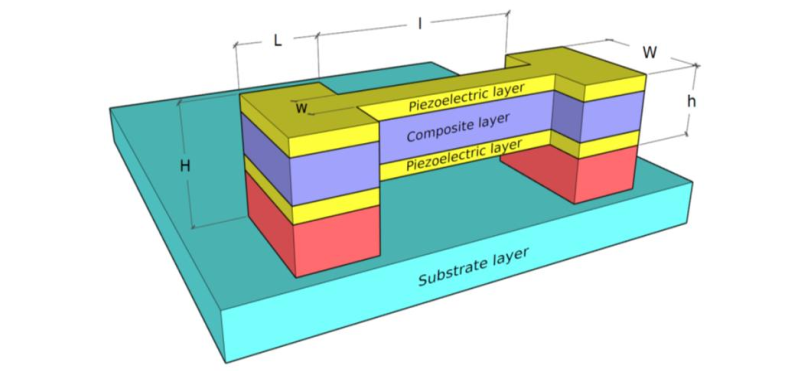
The proposed research project focuses on the optimization of Nanoelectromechanical systems (NEMS) devices, i.e., MEMS devices shrunk to nanometer scale. NEMS are nano-scale devices that consist of miniaturized electrical and mechanical apparatuses such as actuators, beams, sensors, pumps, resonators, and motors. Due to the low power consumption, fast response time, and low mass, NEMS achieve extreme measurement sensitivity and have thus vast potential in many engineering and industrial applications. The design and analysis of any electromechanical system start with understanding the devices’ thermo-electro-mechanical behaviour and their interactions with external forces. When the critical dimension shrinks to the nanometer scale, as in NEMS, the material defects and surface effects significantly impact their performance. To adequately simulate a NEMS device, including damage and fracture at the atomic level that can lead to undesired behaviour, a multiscale multiphysics approach is required. The ultimate goal of the proposal is to develop a reliable, accurate and robust numerical tool that can be extended to capture essential phenomena on the atomic level; however, still computationally efficient enough for practical simulations. First, the project focuses on the challenges of simulating their behaviour, the need for a unified numerical approach, and proposes a meshless numerical methodology to address the problem at hand. The project aims to develop an hp-adaptive multiphysics simulations, enabling the study of NEMS devices in areas such as the effects of material heterogeneity, defects, interfaces, and temperature on NEMS devices. Although general, the proposed methodology will be developed on a use case from piezoelectric NEMS devices implemented as composite plates in nano-scale dimensions. Further, the project focuses on linking numerical simulations with algorithmic geometry modelling tailored to the NEMS. Geometric modelling can result in very complex geometries which in general require manual assistance to properly mesh. Node positioning required by meshless approaches is preferred to meshing, since it can be fully automated even for complex 3-dimensional domains. The results of algorithmic modelling can be coupled with node positioning to form input for the numerical simulation approach. Finally, the project merges computer simulation approach and algorithmic geometry modelling with a stochastic optimization approach to form an optimization framework for NEMS. Both the geometry of NEMS and their properties can be optimized with such a framework. Such an optimization approach is computationally expensive but can benefit greatly from parallelism and is scalable on modern computer systems.
P-Lab team



Funding

M. Chen, Y. Lu, L. Cheng, R. Zhu, K. Tao, Y. Li, M. Wahab; Lightweight underwater acoustic time-frequency separation network for efficient marine target recognition, Ocean Engineering, vol. 343, 2026 [DOI: 10.1016/j.oceaneng.2025.123234] ::
Q. Xiao, C. Wang, Y. Wu, G. Chen, L. Wang, M. Wahab; Understanding fretting fatigue in dovetail joints: Slip accumulation, stick-slip evolution, joint angle and crack initiation, Tribology International, vol. 214, 2026 [DOI: 10.1016/j.triboint.2025.111368] ::
P. Hung, H. Nguyen-Xuan, M. Wahab, C. Thai, P. Phung-Van; Flexoelectricity effects on smart piezoelectric nanoplates using an isogeometric analysis-based Chebyshev shear deformation theory, Computers and Structures, vol. 320, 2026 [DOI: 10.1016/j.compstruc.2025.108033] ::
H. Zahran, A. Zinovev, D. Terentyev, A. Aouf, M. Wahab; A deep learning approach to predict cyclic softening behaviour of irradiated and non-irradiated RAFM steels under low cycle fatigue, European Journal of Mechanics / A Solids, vol. 117, 2026 [DOI: 10.1016/j.euromechsol.2026.106021] ::
Y. Zhang, D. Chen, Y. Wu, L. Wang, M. Wahab; Cross-configuration assessment of functionally graded adhesives in single-lap joints via an elastoplastic ductile-damage framework, International Journal of Adhesion and Adhesives, vol. 147, 2026 [DOI: 10.1016/j.ijadhadh.2026.104285] ::
C. Thai, P. Hung, M. Wahab, P. Phung-Van; Isogeometric evaluation of higher-order shear deformation theories for functionally graded magneto-electro-elastic nanoplates under nonlocal strain gradient elasticity, Engineering Analysis with Boundary Elements, vol. 188, 2026 [DOI: 10.1016/j.enganabound.2026.106745] ::
Y. Ma, Q. Yang, R. Zhu, Y. Li, M. Wahab; Underwater Image Enhancement Via Dual-Path Frequency-Domain Fusion Network, IEEE Transactions on Circuits and Systems for Video Technology, 2026 [DOI: 10.1109/TCSVT.2026.3676253] ::
Y. Lu, Z. Zhu, Y. Li, H. Liu, J. Hou, C. Zhou, M. Wahab; LDS-former: A lightweight dual-stream transformer for real-time acoustic emission monitoring of crack evolution in offshore steel structures, Advanced Engineering Informatics, vol. 74, 2026 [DOI: 10.1016/j.aei.2026.104635] ::
M. Wahab; Ballistic performance of a novel auxetic core in sandwich structures under impact loading, Jnl of Sandwich Structures & Materials, 2026 ::
Z. Wang, J. Liu, K. Li, X. Fang, M. Wahab, Z. Cai; Combined laser shock peening and shot peening for improving fretting wear and low-cycle fatigue performance of Ti-6Al-4V, Optics and Laser Technology, vol. 203, 2026 [DOI: 10.1016/j.optlastec.2026.115900] ::
S. Qin, J. Huang, S. Li, Y. Zhou, M. Wahab; Novel two-stage adaptive weight coefficients for Finite Element Model Updating of a cable-stayed bridge via sensitivity analysis and Kriging model, Mechanical Systems and Signal Processing, vol. 231, 2025 [DOI: 10.1016/j.ymssp.2025.112674] ::
L. Ho, T. Bui-Tien, M. Wahab; A two-step failure identification approach using a stochastic optimization-based ensemble learning model for beams without pristine data, Engineering Structures, vol. 334, 2025 [DOI: 10.1016/j.engstruct.2025.120253] ::
Q. Xiao, C. Wang, B. Ahmed, D. Wang, Z. Cai, L. Wang, M. Wahab; Prediction of fretting fatigue lifetime of dovetail joints using a Modified Theory of Critical Distances, Tribology International, vol. 209, 2025 [DOI: 10.1016/j.triboint.2025.110728] ::
C. Li, S. Han, C. Wang, A. Amanov, L. Wang, M. Wahab; A multiscale finite element approach to analyse the effect of shot peening-induced surface roughness on fretting fatigue crack initiation, Results in Engineering, vol. 26, 2025 [DOI: 10.1016/j.rineng.2025.104998] ::
X. Fang, Z. Wang, M. Wahab, J. Gong, X. Liu, X. Liu, Z. Cai; Fretting wear mechanism of GH4169 dovetail joint specimens treated with hybrid laser shock peening, Tribology International, vol. 209, 2025 [DOI: 10.1016/j.triboint.2025.110740] ::
J. Liu, X. Wang, A. Zinovev, D. Terentyev, L. Wang, M. Wahab; A modified low cycle fatigue Chaboche model for irradiation hardening behaviour of EUROFER97 at elevated temperatures, European Journal of Mechanics / A Solids, vol. 114, 2025 [DOI: 10.1016/j.euromechsol.2025.105737] ::
Y. Guo, G. Kosec, L. Wang, M. Wahab; A Transfer Learning method for deep drawing force prediction of sheet metal, European Journal of Mechanics / A Solids, vol. 114, 2025 [DOI: 10.1016/j.euromechsol.2025.105780] ::
Y. Zhou, F. Yao, Y. Wang, C. Bai, S. Liu, M. Wahab; Free vibration of orthotropic rectangular mindlin plates via spectral element model under arbitrary boundary conditions, Thin-Walled Structures, vol. 216, 2025 [DOI: 10.1016/j.tws.2025.113679] ::
C. Wang, Q. Xiao, Y. Guo, G. Chen, L. Wang, M. Wahab; Fretting fatigue crack propagation lifetime estimation using Long Short-Term Memory network, Engineering Fracture Mechanics, vol. 327, 2025 [DOI: 10.1016/j.engfracmech.2025.111420] ::
H. Zahran, A. Zinovev, D. Terentyev, A. Aouf, M. Wahab; Low cycle fatigue life prediction for neutron-irradiated and nonirradiated RAFM steels via machine learning, Fusion Engineering and Design, vol. 221, 2025 [DOI: 10.1016/j.fusengdes.2025.115394] ::
A. Milan, M. Ayatollahi, R. Faal, M. Wahab; Mixed-mode problem of multiple interacting embedded and edge cracks in a piezoelectric strip under in-plane electro-mechanical loadings, Acta Mechanica, 2025 [DOI: 10.1007/s00707-025-04465-9] ::
I. Katili, S. Natarajan, M. Wahab, S. Widyatmoko; DSQK finite element with assumed orthogonality bending energy and mixed transverse shear strains for thermal buckling analysis of three-layer functionally graded sandwich plates, Composite Structures, vol. 372, 2025 [DOI: 10.1016/j.compstruct.2025.119615] ::
Z. Han, Y. Li, M. Wahab; Polynomial chaos expansion-driven Bayesian inference for multi-parameter identification of large-span curved footbridge, Structures, vol. 80, 2025 [DOI: 10.1016/j.istruc.2025.110035] ::
B. Ahmed, C. Wang, D. Wang, Y. Zhou, L. Wang, M. Wahab; Fretting fatigue crack initiation behaviour of Ti-6Al-4V and IN-100 alloys at elevated temperatures, International Journal of Solids and Structures, vol. 322, 2025 [DOI: 10.1016/j.ijsolstr.2025.113633] ::
J. Yuan, Y. Zhou, Y. Zhang, M. Wahab; A large-stroke and adjustable-load magnetic quasi-zero stiffness isolator, Mechanical Systems and Signal Processing, vol. 239, 2025 [DOI: 10.1016/j.ymssp.2025.113326] ::
P. Hung, M. Wahab, P. Phung-Van, C. Thai; A refined size-dependent modified strain gradient analysis of graphene platelet-reinforced functionally graded triply periodic minimal surface microplates using isogeometric analysis, Engineering Analysis with Boundary Elements, vol. 180, 2025 [DOI: 10.1016/j.enganabound.2025.106442] ::
X. Zhang, Q. Zhao, H. Zhang, Z. Zhai, X. Chen, Y. Hu, Z. Han, N. Zhang, Y. Gui, M. Wahab; Crystal plasticity-based intergranular facture simulation of AA 5083 aluminum alloy for tri-junction grain boundary, International Journal of Fracture, 2025 [DOI: 10.1007/s10704-025-00892-w] ::